
Cold Laser vs Red Light Therapy: Which One Do You Need?
We get this question in the clinic almost every week. A patient reads about red light therapy, then sees that we also offer laser therapy, and asks the obvious question: aren’t those the same thing?
Fair question. Both use light. Both are painless. Both work on your cells rather than masking symptoms. If you looked only at the science, you would be forgiven for thinking they are two names for one treatment.
But there is a real difference, and it is not really about the physics. It is about how the light gets delivered and what that makes each one good at. One is precise and targeted. The other covers ground. Which one suits you depends entirely on what you are dealing with.
Here is how we think about it, and how we decide which one a patient actually needs.
The science underneath is the same
Both treatments work through a process called photobiomodulation.
Certain wavelengths of red and near infrared light pass through your skin and reach the tissue beneath. Inside your cells, the mitochondria absorb that light. Mitochondria are the parts of your cells that produce energy in the form of ATP.
When they absorb this light, ATP production increases. More cellular energy means your body can do repair work more efficiently. Circulation improves. Inflammatory activity settles down. Tissue heals faster than it otherwise would.
That mechanism is identical whether the light comes from a laser or from an LED array. This is the part people get confused about, and honestly the confusion is understandable, because the underlying biology genuinely is the same.
The difference is in the delivery.
What cold laser therapy is
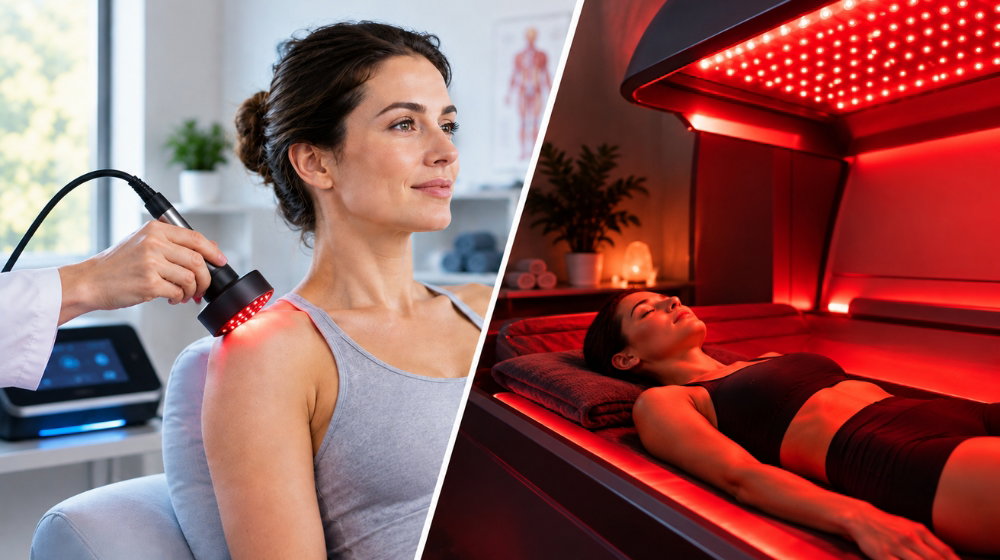
Cold laser therapy, also called low level laser therapy or LLLT, uses a handheld device that concentrates light into a narrow, focused beam.
Laser light is coherent, which means the light waves travel in step with each other in a tight column rather than scattering. In practical terms that gives you a concentrated dose of energy delivered to a small, specific area, with good depth of penetration.
The word “cold” simply distinguishes it from surgical lasers. It does not heat or cut tissue. Most patients feel nothing at all, or a mild warmth.
In our clinic, a laser session means a practitioner holding the device over a specific spot. A knee. An elbow. A section of the lower back. The area treated is usually about the size of a hand or smaller, and sessions typically run around five to fifteen minutes depending on how many areas need attention.
You can read more about the mechanism in our earlier post on how laser therapy supports tissue repair.
What red light therapy is
Red light therapy uses arrays of LEDs rather than a laser diode.
LED light is not coherent. It spreads out. On its own that sounds like a disadvantage, but it is exactly what makes the treatment useful, because it means you can cover a large surface area at once instead of treating one spot at a time.
Our red light therapy setup uses professional grade equipment with a therapeutic output well above what consumer devices deliver. Sessions run around ten to fifteen minutes and you simply relax while the light does its work. No contact, no discomfort, nothing to hold.
The equipment also runs multiple wavelengths in the red and near infrared range, and different protocols use different combinations depending on what is being treated. Red wavelengths tend to work closer to the surface, which is why skin and superficial tissue respond well. Near infrared travels deeper, which is why it is used for joints, muscles and recovery work.
The practical difference
Here is the version we give patients when they ask.
Cold laser is a spotlight. Red light therapy is floodlighting.
If you have one clearly defined problem area, the spotlight is what you want. Concentrated energy, delivered exactly where the issue is, with good depth. A specific injured tendon does not benefit from treating your whole body. It benefits from a strong, focused dose in one place.
If your issue is spread across a large area, involves several regions at once, or is more about overall recovery than one specific injury, floodlighting makes far more sense. Treating a large area with a handheld device would take an unreasonable amount of time. The LED array does it in one session.
Neither is better. They are built for different jobs.
Which one fits your situation
Cold laser therapy tends to be the better fit for:
- A specific injury with a clear location, such as plantar fasciitis, tennis elbow, or a strained rotator cuff
- Tendonitis and other localised soft tissue problems
- One arthritic joint that is giving you trouble
- Trigger points and focused areas of muscle tension
- Nerve irritation in a defined spot, such as carpal tunnel symptoms
- Localised wound and tissue healing
- Cases where depth in one place matters more than coverage
Red light therapy tends to be the better fit for:
- Widespread aches, or pain in several areas at once
- General muscle recovery after training or physical work
- Arthritis affecting multiple joints
- Overall inflammation and fatigue
- Skin health and appearance across a broad area
- Ongoing maintenance and recovery as part of a routine
- Cases where you want consistent regular sessions rather than targeted treatment episodes
Both often make sense when:
- You have one significant injury plus general stiffness or slow recovery
- You are recovering from surgery and want both site-specific healing and broader support
- A chronic condition has both a focal point and a systemic component
Why we use both
Most clinics offer one or the other. Life Balance Wellness offers both, and that is deliberate.
A patient comes in with lower back pain that flares up and radiates. There is a specific joint involved, and there is also broad muscular guarding across the whole lower back and hips. Treating only the specific joint leaves the surrounding tension untouched. Treating only the broad area misses the joint that is driving it.
So the plan might involve chiropractic adjustments to address alignment, cold laser on the specific irritated structure, and red light sessions to support recovery across the wider area between visits.
This is how we work generally. Neither light therapy is a standalone product on a menu. Both are tools that get selected based on what your assessment shows. Dr. Alecia Arn has been building combined treatment plans like this for over 22 years, and the sequencing genuinely matters. What you treat first, and with what, changes the result.
What to expect either way
- Neither hurts. Most people feel nothing, or gentle warmth. Several patients fall asleep during red light sessions.
- No downtime. Walk out and carry on with your day. No recovery period, nothing to avoid.
- Results build up. This is the part worth understanding. Neither treatment is a single dose fix. You are supporting a biological repair process, and repair takes time. Some people notice a difference after two or three sessions. Others need several weeks before the change is obvious. Most patients start with two to three sessions per week and then move to a maintenance schedule.
- Consistency beats intensity. Regular sessions over several weeks outperform occasional intensive bursts.
- They are not for everyone. Light therapy is generally not recommended during pregnancy, over an area with active cancer, if you are taking photosensitizing medication, or with certain light sensitive conditions. We review your health history before your first session, every time.
How to decide without guessing
You do not need to work this out on your own, and honestly, picking based on an article is the wrong way to do it.
The useful question is not “which treatment is better.” It is “what is causing my problem, and what does that call for.” Sometimes the answer is neither of these, and what you actually need is an adjustment, or a look at what is driving inflammation from the inside.
That is why we assess first. We look at what is going on, what you have already tried, and what else is in your care plan, then decide what fits.
If you are dealing with pain that has not resolved, an injury that is healing slowly, or fatigue and inflammation that will not shift, come and talk to us. We see patients at our Roscoe clinic from Rockford, Loves Park, Machesney Park, Rockton, South Beloit, and from Beloit and Janesville in Wisconsin.
Call (815) 623-0444 or book a consultation and we will work out which approach makes sense for you.
Contact
Business Hours
Monday: 8:00 AM to 12:00 PM; 2:00 PM to 6:00 PM
Tuesday: 8:00 AM to 12:00 PM
Wednesday: 8:00 AM to 12:00 PM; 2:00 PM to 6:00 PM
Thursday: 8:00 AM to 12:00 PM; 2:00 PM to 5:00 PM
Friday/Saturday/Sunday: Closed