
At-Home Red Light Therapy vs Professional Treatment
There is a good chance you know someone who owns a red light mask. Maybe you own one yourself. It showed up in your feed, the reviews looked convincing, and for about three weeks you used it every night. Then it moved to a drawer, and it has been there ever since.
You are not alone in this. Red light therapy has moved from a niche recovery tool used by athletes to something ordinary people buy for their bathroom counter. More than half of Americans under 35 now say they have tried or looked into tools like red light therapy, according to survey data released in 2026.
Here is the part that gets lost in all the marketing. When a home device does not deliver, most people conclude that red light therapy does not work. Usually that is the wrong conclusion. The therapy works. The dose did not.
This post explains what actually separates a consumer device from a professional system, in plain language and without the jargon. By the end you will know how to judge any red-light device you come across, including the one already sitting in your drawer.
Why red light therapy is suddenly everywhere
A few years ago, red light therapy lived in physical therapy clinics and pro sports facilities. Now it is sold as a mask, a wand, a wrap, and a folding panel.
The 2026 wellness survey data gives a decent picture of why people buy. Better skin appearance was the most commonly reported benefit at 36%. Improved sleep and better muscle and joint comfort each came in at 29%. Those are real, everyday reasons, and they explain why the category grew so fast.
The flip side is a market full of claims that nobody is checking. Health experts have started pushing back publicly on social media promises around red light, drawing a firmer line between the uses with solid research behind them and the ones that are mostly hype. That scrutiny is healthy. It just leaves buyers with a harder job.
The one number that decides almost everything
If you remember one thing from this post, make it this: irradiance.
Irradiance is how much light energy actually reaches your skin, measured in milliwatts per square centimeter, written as mW/cm². Multiply that by how long you sit under the light and you get your dose.
Think of it like watering a lawn. A spray bottle and a sprinkler both put out water. Stand there long enough with the spray bottle and yes, the grass gets damp. But there is a point where the spray bottle simply cannot deliver enough water to soak the roots, no matter how patient you are. Light works in a similar way. Too little energy reaching the tissue and the cellular response you are after does not happen in any meaningful way.
This is where consumer devices run into trouble. Published output numbers across the industry vary wildly, and the way those numbers are measured varies just as much. Some are taken with the sensor pressed right against the LEDs rather than at the distance you would actually use the device. That single choice can change a number dramatically.
Independent lab testing exists precisely because of this gap. The LumaPod system we use at Life Balance Wellness was tested by LightLab International in December 2025, which measured spectral irradiance from 300 to 1050nm across fifteen points on the treatment surface plus five more from the lid at typical treatment distance. It came back with a verified true irradiance up to 73.9 mW/cm².
The reason to care about that report is not the number by itself. It is that the number was measured by someone with no stake in selling the machine.
Coverage: treating a spot versus treating a body
The second difference is simpler to picture.
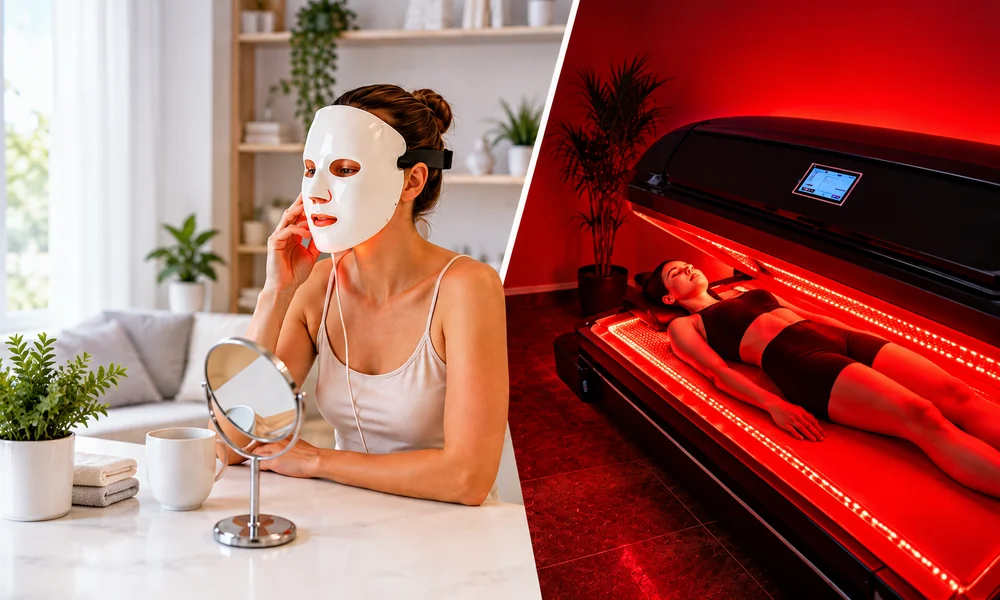
A handheld device treats roughly the area of your palm. A mask treats your face. A small panel treats whatever fits in front of it, usually one shoulder or one knee at a time.
Our LumaPod is a full body bed with a treatment surface of 88 by 36 inches and close to 27,000 LEDs. You lie down and your entire body is being treated at once, front side in one position, back side in another.
Why does that matter beyond convenience? Because a lot of what makes red light useful is not purely local. Improved circulation and reduced systemic inflammation are body-wide responses. If you are dealing with widespread stiffness, general fatigue, or recovery after hard training, treating one knee for ten minutes is a different intervention entirely from treating everything at once.
There is also a practical side. Treating six areas with a handheld device means six separate sessions, or one very long evening. Most people give up long before they reach a useful number of sessions.
Not all red light is the same light
Red light therapy is a category, not a single thing. Different wavelengths reach different depths.
- Red light, roughly 630 to 660nm. Absorbed at the skin and the tissue just beneath it. This is the range most associated with skin tone, texture, collagen support, and surface healing.
- Near infrared, roughly 810 to 940nm. You cannot really see it, and it travels deeper. This is the range that matters for muscle, joint, connective tissue, and nerve related concerns.
Plenty of home devices run a single wavelength, or a red and near infrared pair such as 660 and 850nm. That is not useless. It is just narrow.
The LumaPod runs five validated wavelengths together: 633nm, 660nm, 810nm, 850nm, and 940nm. Surface and depth at the same time, in one session. If your goal involves both skin and joints, or both recovery and general energy, that spread does real work.
For a fuller explanation of how absorbed light turns into cellular energy, our red light therapy page walks through the mechanism step by step. If you want to see how this compares to other light-based treatments, our post on how laser therapy accelerates tissue repair covers the science in more depth.
The part nobody mentions: knowing what you are doing
Buy a home panel and you get a device and a manual. What you do with it is your problem.
How far away should you sit? How long? How many days a week? Should you do it in the morning or before bed? Does it interact with the medication you take? Nobody is answering those questions for you, and the answers genuinely differ depending on what you are treating.
Our system includes 63 preset protocols built around specific applications, from tissue recovery to skin health. Before your first session, our team reviews your health history and goals and picks the protocol that fits. Our clinic is led by Dr. Alecia Arn, DC, who has been treating patients for over two decades. Red light gets fitted into your wider care plan rather than handed to you as a standalone gadget.
That review matters for safety too. Some people should not use red light at all, and others need clearance before they start. Are you pregnant? On a medication that makes your skin more reactive to light? Living with a condition where light exposure is already a concern? Any of those needs a conversation with a provider first. A device shipped to your door will never think to ask.
There is also the simple issue of follow-through. Patients who book sessions two or three times a week actually complete them. Devices bought with the best intentions tend to get used enthusiastically for two weeks and then forgotten. Red light therapy is cumulative. Consistency is not a small detail, it is most of the outcome.
Where home devices genuinely make sense
None of this means you wasted your money. Home devices have a real place.
They are good for maintenance between clinical sessions. They are reasonable for surface level skin goals, since that work happens close to the surface where a lower output device can still deliver a sensible dose over time. They are convenient, private, and available at eleven at night. And a small device you actually use beats a great one you never book.
The honest framing is not home versus clinic. It is matching the tool to the job. Nobody buys a treadmill and cancels their physical therapy. The two do different work.
If you have chronic pain that has not responded to anything, if you are recovering from an injury, if you are exhausted despite sleeping fine, or if you want to see whether red light does anything for you at all before investing further, a professional session gives you a real answer at a real dose. Then you can decide what makes sense to do at home.
How to judge any red-light device
Whether you are shopping online or comparing clinics, five questions will tell you almost everything.
- Is there a third-party test report? Not a marketing number on the box. An independent lab result you can actually look at. If the seller will not show one, treat the specs as advertising.
- At what distance was irradiance measured? A number taken at the LED surface tells you almost nothing about what reaches your body six or twelve inches away.
- Which wavelengths, and how many? Ask for specific figures in nanometers. “Red and infrared” without numbers is not an answer.
- How large is the treatment area? Then be realistic about how many sessions it takes to cover what you actually need treated.
- Who is telling you how to use it? A protocol built for your situation beats guessing, every time.
The bottom line
Red light therapy has strong research behind it and a marketing problem in front of it. Most disappointing experiences trace back to underpowered devices, patchy coverage, or a schedule nobody kept, not to the therapy itself.
If you have already tried a home device and felt nothing, that is worth testing properly before you write the whole thing off. A supervised session on professional equipment, at a verified output, with a protocol chosen for your specific concern, is a genuinely different experience.
Life Balance Wellness serves patients across the Stateline area from our Roscoe clinic, including Rockford, Loves Park, Machesney Park, Rockton, South Beloit, and nearby Beloit and Janesville, Wisconsin. If you want to know whether red light therapy fits into your care plan, call us at (815) 623-0444 or book a session online. We are happy to answer your questions first, with no obligation to book anything.
Contact
Business Hours
Monday: 8:00 AM to 12:00 PM; 2:00 PM to 6:00 PM
Tuesday: 8:00 AM to 12:00 PM
Wednesday: 8:00 AM to 12:00 PM; 2:00 PM to 6:00 PM
Thursday: 8:00 AM to 12:00 PM; 2:00 PM to 5:00 PM
Friday/Saturday/Sunday: Closed