
Is It Sciatica? How to Tell What's Causing Your Leg Pain
Someone told you it was sciatica. Maybe a friend, maybe a search result, maybe a doctor who had six minutes.
Here is the thing. Sciatica is not a diagnosis. It is a description. It means the sciatic nerve is irritated, and that leaves the actual question wide open: irritated by what, and where?
At least four different problems produce leg pain that people call sciatica. They need different treatment. Some respond quickly. One of them is not a nerve problem at all.
So rather than tell you what sciatica is, let’s work out what you have. Answer these as you read.
Question 1: Does the pain travel below your knee?
This is the first fork in the road.
True sciatic nerve pain usually travels past the knee. It runs down the back or side of the calf and often into the foot. It follows a line, not a patch.
Pain that stops at the buttock, or in the back of the thigh, and never gets past the knee is more likely coming from a joint or muscle rather than the nerve root.
Below the knee: keep going, this is likely nerve involvement.
Stops above the knee: jump to Question 5.
Question 2: Is there numbness, tingling, or pins and needles?
Nerves do more than carry pain. They carry sensation and they drive muscles.
When a nerve root is genuinely compressed or irritated, you usually get more than ache. You get numbness in a patch of skin, a pins-and-needles feeling, a cold or burning sensation, or weakness.
Pure aching with normal sensation points more toward muscle or joint. Aching plus altered sensation points toward nerve.
If you have noticed your foot slapping when you walk, or you have tripped on nothing, or you cannot push up onto your toes on one side, that is motor weakness. Get that assessed soon rather than at some point.
Question 3: What makes it worse?
This question separates the two most common causes better than almost anything else.
Worse with sitting, bending forward, coughing or sneezing. That pattern suggests a disc. Sitting and forward bending raise pressure in the lumbar discs. If twenty minutes in the car is torture and standing up is relief, a disc is the likely source. This pattern is more common under 50.
Worse with standing and walking, better when you sit or lean forward. That suggests spinal stenosis, a narrowing of the space the nerves pass through. Classic sign: you can push a shopping cart around the grocery store for an hour with no trouble, because leaning forward opens the space, but walking upright across the parking lot sets it off. More common over 60.
Worse after sitting on a wallet, or driving, or sitting cross-legged. That points toward the piriformis muscle, which sits directly over the sciatic nerve in the buttock. When it tightens, it can compress the nerve on its way past.
Worse first thing in the morning, eases after moving. Often joint related rather than nerve.
Question 4: Can you point to where it starts?
Ask yourself where the pain begins before it travels.
Starts in the low back, then goes down the leg. Disc or nerve root, most likely. If the low back pain is the bigger problem than the leg, start there.
Starts deep in the buttock, then goes down. Could be piriformis, could be the sacroiliac joint.
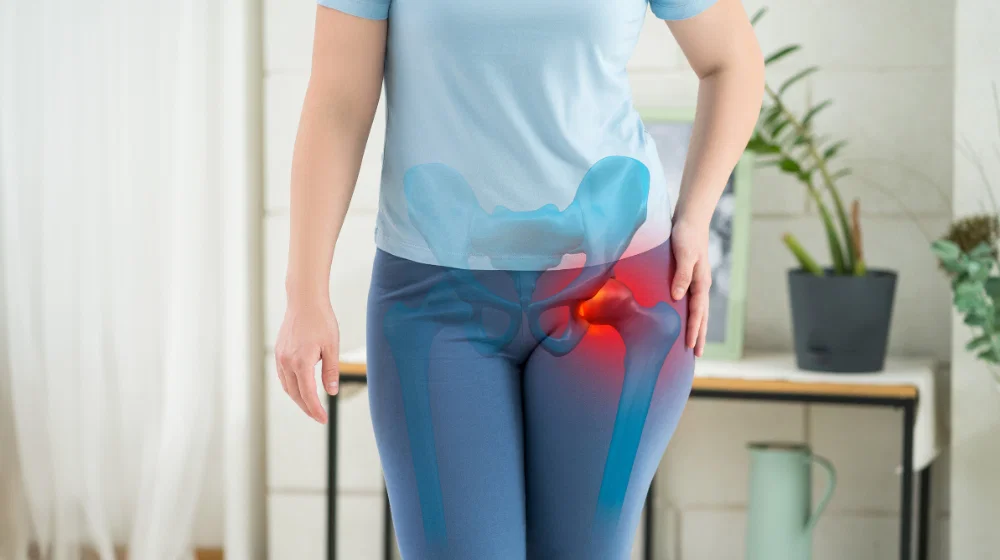
Starts in the groin or front of the hip. This one matters. Hip joint arthritis refers pain into the groin and down the front of the thigh, and it gets mistaken for sciatica constantly. If the pain is front-of-thigh and groin rather than back-of-leg, the hip joint is worth examining before the spine.
No clear start, it is just everywhere. Usually means more than one thing is going on, which is common in people who have had this for years.
Question 5: If it stops above the knee, where exactly?
Pain in the buttock and back of the thigh that never travels further is frequently the sacroiliac joint. That is the joint where your pelvis meets your spine, low down and off to one side.
The tell is location. People with SI joint problems can usually put one finger on the spot, just inside the back of the hip bone. Nerve pain is harder to pinpoint because it runs in a line.
SI joint problems are especially common after pregnancy, after a fall onto one side, or in people whose job has them standing on one leg or climbing in and out of a vehicle all day.
Question 6: How long has this been going on?
Under six weeks. Many cases of genuine disc-related sciatica settle on their own within this window. Staying active helps. Bed rest does not. If it is improving week on week, that is a good sign.
Six weeks to three months. This is the point where it stops being worth waiting out. Nerve irritation that persists tends to become harder to shift the longer it continues.
Over three months. Changes are usually present beyond the original problem. Muscles have adapted and guarded. Movement patterns have changed. The other hip is now doing extra work. Treatment takes longer and needs to address more than the original site.
Years, with flare-ups. Something structural keeps being provoked. The useful question here is not what to do during flares but what keeps setting it off. Long-running pain is rarely just a sign of getting older, either.
Stop reading and get checked today if any of these apply
These are uncommon, but they matter more than everything else on this page.
- Numbness in the saddle area, meaning inner thighs, buttocks or genitals
- Difficulty controlling your bladder or bowels, or difficulty starting urination
- Weakness in both legs
- Sudden severe leg weakness
- Leg pain with fever, or with unexplained weight loss
- Pain that came on immediately after a significant fall or accident
The first two together can indicate cauda equina syndrome, which is a surgical emergency. Go to an emergency department, do not wait for an appointment.
So what do the answers mean?
Rough guide, based on where you landed:
Below-knee pain, altered sensation, worse sitting and bending. Likely disc-related nerve root irritation. Usually responds well to treatment aimed at reducing the compression and restoring movement.
Below-knee pain, worse standing and walking, better leaning forward, over 60. Likely stenosis. Different approach, and management focuses on maintaining function and reducing irritation.
Buttock pain into the back of the thigh, worse sitting on hard surfaces. Likely piriformis involvement. Often responds quickly once the muscle is addressed properly.
Sharp localised buttock pain you can point to, no travel past the knee. Likely SI joint. Responds well to joint-specific work.
Groin and front-of-thigh pain. Possibly the hip joint, not the spine at all. Worth ruling in or out early, because treating the back for a hip problem gets you nowhere.
What happens at our clinic
We do not treat sciatica. We treat whichever of the above you actually have, which is why the first visit is an assessment.
That means testing nerve function, checking which movements reproduce your pain and which relieve it, examining the hip and SI joint separately from the spine, and looking at how you move overall.
Depending on what we find, treatment might involve chiropractic adjustments to restore movement where it has been lost, soft tissue work for the muscles involved, laser therapy to settle inflammation around an irritated nerve, frequency specific microcurrent for nerve irritation, and specific exercise so the problem does not rebuild.
Dr. Alecia Arn has been assessing leg pain for over 22 years, and the pattern she sees most often is people who have been treated for the wrong thing for months.
Three things that help almost everyone while you sort it out
Keep moving. Walking is usually fine and usually helps. Resting in bed makes most types worse.
Change position every twenty to thirty minutes. Whatever position hurts, the fix is not avoiding it forever. It is not holding it for an hour.
Note what makes it better. Most people can list what makes it worse. Far fewer notice what eases it, and that information is more useful diagnostically than you would think.
Get a real answer
If you have been managing leg pain for months without knowing what is causing it, an assessment will tell you more in forty minutes than another few months of guessing.
Our clinic is in Roscoe and we see patients from Rockford, Loves Park, Machesney Park, Rockton, South Beloit, Beloit and Janesville.
Call (815) 623-0444 or book an assessment. Bring your answers to the six questions above. It will make the first visit considerably more useful.
Contact
Business Hours
Monday: 8:00 AM to 12:00 PM; 2:00 PM to 6:00 PM
Tuesday: 8:00 AM to 12:00 PM
Wednesday: 8:00 AM to 12:00 PM; 2:00 PM to 6:00 PM
Thursday: 8:00 AM to 12:00 PM; 2:00 PM to 5:00 PM
Friday/Saturday/Sunday: Closed