
Why Your Weight Loss Stalled and What Actually Restarts It
The first few weeks went well. You cut back on the snacking, started walking most evenings, maybe dropped ten or twelve pounds. It felt like the hard part was over.
Then the scale stopped.
Not for a few days. For three weeks. Then five. You are doing the same things that worked in February, and the number has not moved since April. If anything, you feel more tired than you did at the start.
This is one of the most common frustrations we hear from patients, and it is almost never a discipline problem. A stall is information. It means something in your body has changed in response to the weight you already lost, and the plan that got you here is no longer the plan that takes you further.
Here is what is actually happening when weight loss stops, and what to do about it.
First, is it really a plateau?
Weight fluctuates. Water retention from a salty meal, hormonal shifts, a heavier training week, even constipation can hold the number steady or push it up for several days at a time.
A true plateau is when your weight has not moved in any direction for at least three to four weeks while your habits have stayed consistent.
If it has been eight days, you are probably fine. Keep going. If it has been a month or more, something structural is going on and it is worth looking at properly.
One more thing worth checking before you panic: are you losing inches even if the scale is flat? If your clothes fit better and your measurements are down, you are losing fat and gaining or holding muscle. That is progress. The scale is just a bad instrument for measuring it.
Reason 1: Your body needs less fuel than it used to
This is the one almost nobody accounts for.
A body carrying 210 pounds burns more energy doing absolutely nothing than the same body at 185 pounds. Less tissue to maintain, less weight to move around, less work for the heart. So the calorie intake that created a deficit at your starting weight can be close to maintenance at your current weight.
You did not do anything wrong. You succeeded, and success moved the target.
On top of that, your body adapts. When food intake drops for an extended period, energy expenditure tends to fall a little further than the weight change alone would predict. You fidget less. You move less without noticing. Body temperature drops slightly. It is an old survival mechanism and it works whether you want it to or not.
Reason 2: You lost muscle along with the fat
If you dropped weight quickly, ate low protein, or did mostly cardio and no resistance work, some of what you lost was muscle.
Muscle is metabolically active. Losing it lowers the amount of energy you burn at rest, which makes the next pound harder than the last one. It also changes how you look. Two people at the same weight can look completely different depending on how much muscle they carry.
This is why we care about body composition and not just the number on the scale. Losing thirty pounds of which eight is muscle is a very different outcome from losing thirty pounds of which two is muscle, even though the scale reads the same.
Reason 3: Your thyroid is not keeping up
Your thyroid sets the pace of your metabolism. When it slows down, everything slows down with it.
The signs often get blamed on other things:
- Feeling cold when nobody else is
- Fatigue that sleep does not fix
- Dry skin, thinning hair, brittle nails
- Constipation
- Brain fog
- Weight that will not move no matter what you do
Here is where it gets frustrating for a lot of people. You go in, get bloodwork, and are told your thyroid is normal. Often that means only TSH was tested. A fuller picture includes free T4, free T3, reverse T3 and thyroid antibodies, because you can have a TSH inside the reference range and still have poor thyroid function at the tissue level.
If your stall came with three or four of those symptoms, this is worth investigating properly rather than assuming you just need to try harder.
Reason 4: Stress and sleep are working against you
Cortisol is your main stress hormone, and chronically high cortisol makes weight loss genuinely harder. It encourages fat storage around the abdomen, drives cravings for sugar and refined carbs, and interferes with blood sugar control.
Poor sleep does the same thing from a different direction. A run of short nights raises ghrelin, which makes you hungrier, and lowers leptin, which is what tells you that you have had enough. You are not imagining the 9pm snack cravings after a bad week of sleep. Your appetite signalling is genuinely altered.
If you are sleeping six hours, working long shifts, and running on stress, you can eat perfectly and still not lose. The plan is not the problem. The environment the plan is operating in is the problem.
Reason 5: Blood sugar swings
When insulin is consistently elevated, your body is in storage mode rather than burning mode.
The pattern is easy to recognise once you know it. You eat, feel fine for an hour, then crash. You get shaky or irritable if a meal is late. You are hungry again ninety minutes after eating. Afternoon energy dips are a daily event.
Insulin resistance builds gradually and it makes fat loss significantly harder, especially around the midsection. It also tends to come as a package with fatigue, cravings and poor sleep, so it often sits underneath several of the other reasons on this list.
Reason 6: You have been dieting too long without a break
Months of continuous restriction is not a neutral state for the body. Extended low intake can suppress thyroid output, raise cortisol, disrupt reproductive hormones, and drive down the energy you burn through daily movement.
Cutting further at this point usually backfires. The instinct when the scale stops is to eat less and exercise more, but when the stall is being driven by adaptation, that is pouring fuel on the fire.
Sometimes the right move is to eat a bit more for a period, get protein up, sleep properly, lift some weights, and let things recover before pushing again. That is a hard sell when you want results now, but it works far better than grinding down.
Reason 7: Portions have quietly crept up
This one is less interesting than the others but it is real, so it belongs on the list.
Over several months, portions expand. A tablespoon of oil becomes a generous pour. Weekends loosen up. The handful of nuts becomes two handfuls. Nobody is being dishonest. It is just what happens when a routine becomes automatic.
If you tracked carefully at the start and stopped, spending a week logging honestly will tell you quickly whether this is part of the picture. If it is, the fix is simple. If it is not, you have ruled it out and can look elsewhere.
What to actually do about it
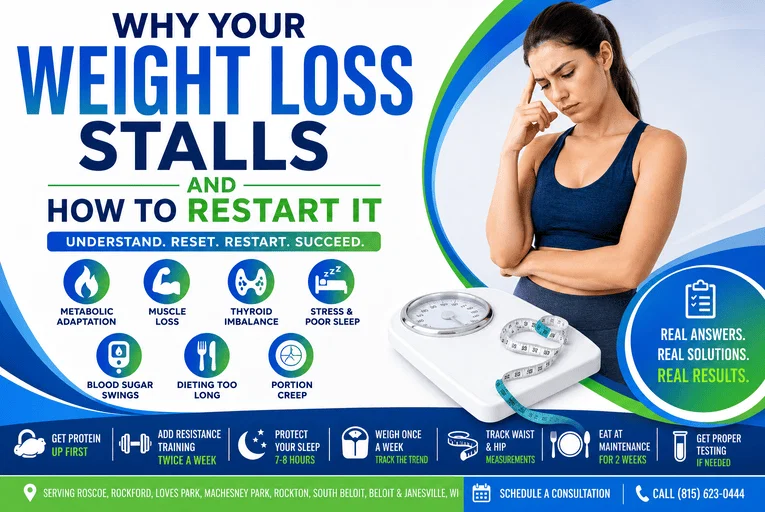
Get protein up first. Most people who stall are under-eating protein. It protects muscle during weight loss, keeps you full longer, and takes more energy to digest than fat or carbs.
Add resistance training twice a week. Not more cardio. Cardio burns energy during the session. Building muscle changes what your body does the rest of the week. Two sessions is enough to make a real difference.
Protect your sleep for two weeks. Treat it as part of the plan rather than something you get to if there is time. Seven to eight hours, consistent bed and wake times. For a lot of people this alone breaks the stall.
Stop weighing daily. Weigh once a week, same day, same time, and track the trend across a month. Daily weighing gives you noise and noise makes people quit.
Track waist and hip measurements. These often keep improving while the scale sits still, and seeing that keeps you going.
Eat at maintenance for a couple of weeks. Especially if you have been restricting for three months or more. It feels counterintuitive and it is often exactly what is needed.
Get proper testing if symptoms point that way. If you have the thyroid signs, the blood sugar pattern, or the stress and sleep picture, guessing wastes months. Testing gives you an answer.
When it is time to stop guessing
There is a point where trying another approach on your own stops making sense. If you have been stalled for more than two months, if you are more tired than when you started, or if the symptoms in this article are describing your week fairly accurately, the useful next step is finding out what is going on inside rather than adjusting the plan again.
That is the approach we take at Life Balance Wellness. Our medical weight loss program starts by looking at metabolism, thyroid, hormones, blood sugar and inflammation, because those are the things that decide whether your effort translates into results. From there we build a plan around what your body actually needs.
Patients come to us from Roscoe, Rockford, Loves Park, Machesney Park, Rockton, South Beloit, and from Beloit and Janesville in Wisconsin, usually after doing everything right and getting nowhere.
A stall is not the end of your progress. It is your body telling you the plan needs to change. Schedule a consultation or call us at (815) 623-0444 and let us find out what is holding things up.
Contact
Business Hours
Monday: 8:00 AM to 12:00 PM; 2:00 PM to 6:00 PM
Tuesday: 8:00 AM to 12:00 PM
Wednesday: 8:00 AM to 12:00 PM; 2:00 PM to 6:00 PM
Thursday: 8:00 AM to 12:00 PM; 2:00 PM to 5:00 PM
Friday/Saturday/Sunday: Closed